
What If More Products Were Designed to Be Repaired?
If only every company thought a little more about what happens after the sale.
When we talk about sustainability, the conversation often turns to recycling, packaging, energy efficiency and the materials used to manufacture a product.
All of those things matter.
But at illumos, we think there's another question manufacturers should be asking much earlier in the design process:
What happens when one component eventually fails?
Does the whole product have to be replaced?
Or was it designed so that the part can be repaired or replaced, allowing everything else to continue doing its job?
It's a simple distinction, but over thousands of products and years of operation, the difference can become significant.
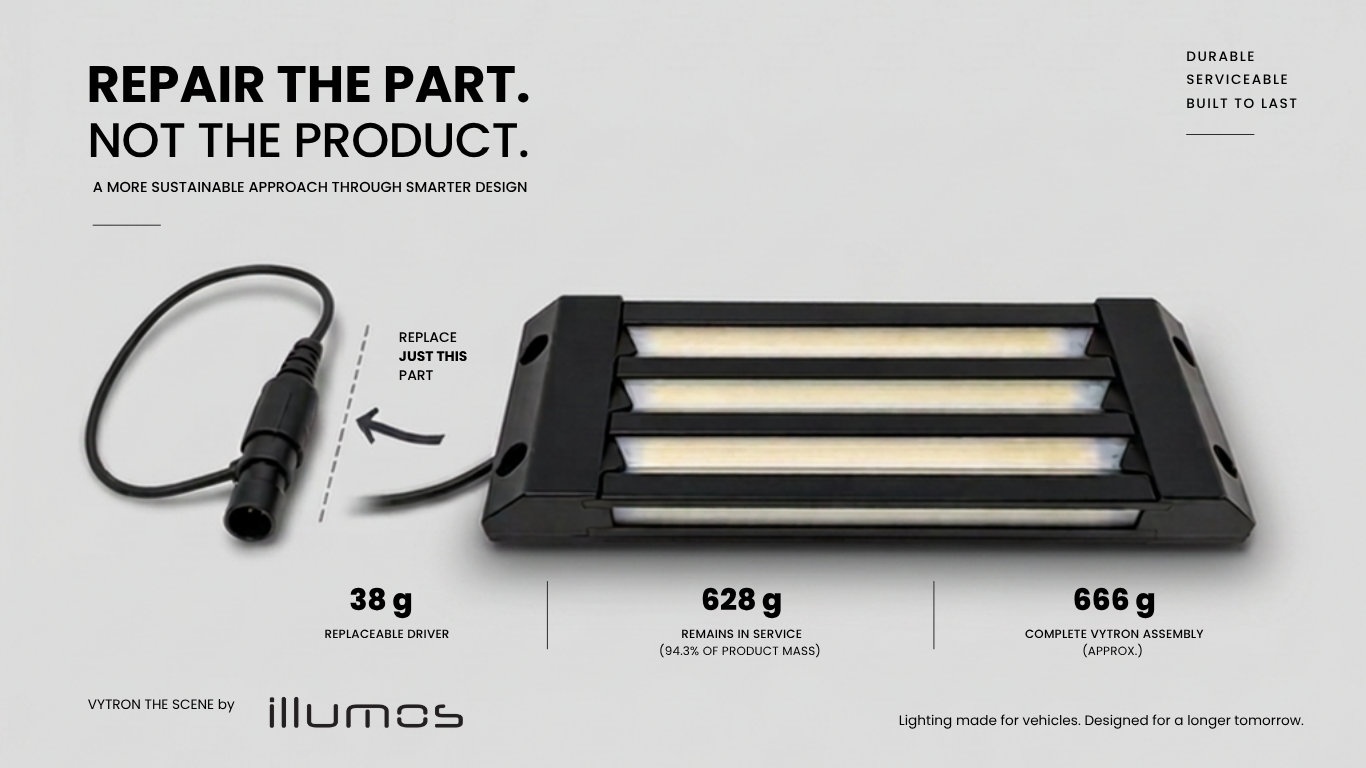
Replace 38 g. Not 666 g.
Take our Vytron commercial vehicle scene light as an example.
A complete Vytron assembly weighs approximately 666 g. Its external driver weighs just 38 g.
We deliberately locate the driver outside the light.
Why?
Because if a fault is isolated to the driver, it can be replaced independently rather than automatically requiring replacement of the complete luminaire.
That means approximately 628 g - 94.3% of the product's weight - can remain in service when only the 38 g driver requires replacement.
It's a small component.
But the thinking behind it is much bigger.
Now multiply that thinking.
Consider a hypothetical comparison with a non-serviceable 666 g light where an integrated driver cannot be replaced independently.
If the driver failed, replacement of the complete light could mean replacing 666 g of product.
With the Vytron approach, a driver-only replacement means replacing 38 g.
The difference is 628 g per driver failure.
It doesn't sound enormous until you scale it.
100 driver replacements: 3.8 kg replaced instead of 66.6 kg - 62.8 kg of product remains in service.
1,000 driver replacements: 38 kg replaced instead of 666 kg - 628 kg remains in service.
10,000 driver replacements: 380 kg replaced instead of 6.66 tonnes - 6.28 tonnes remains in service.
That's not a prediction of how many drivers will fail, nor is it a claim about landfill or carbon savings. It's simply an illustration of the difference that designing a component to be independently replaceable can make when that component eventually needs attention.
Repair before replace.
This philosophy isn't unique to illumos. It's increasingly reflected in the wider approach to electrical product design and waste.
UK WEEE regulations are intended to reduce electrical and electronic equipment being incinerated or sent to landfill, with measures encouraging the recovery, reuse and recycling of products and components.
Environment Agency guidance also makes an important distinction around repair: electrical equipment sent for repair and returned to its owner for reuse can continue to be regarded as electrical equipment rather than waste.
Even lighting regulation is moving in this direction. UK ecodesign documentation discusses encouraging manufacturers to design dismantlable and reusable luminaires, so products don't necessarily have to be disposed of when an internal component fails.
So perhaps the question shouldn't simply be: "Can this product be recycled?"
Maybe we should first ask: "Did it need to become waste in the first place?"
Sustainability starts at the drawing board.
For us, repairability isn't something to consider at the end of a product's life.
It starts at the beginning.
It's part of the reason we use all-metal construction across our commercial vehicle lighting range.
It's why we design products for durability and longevity.
And it's why separating serviceable components such as the driver from the main luminaire makes sense.
A product that lasts longer doesn't need replacing as frequently.
A component that can be replaced independently doesn't necessarily require the rest of the product to be discarded with it.
And a product designed with repair in mind has a better opportunity to remain useful for longer.
That's the kind of sustainability we believe manufacturers can influence directly.
What if more of us thought this way?
We're not suggesting every product can last forever.
Components fail. Technology changes. Vehicles reach the end of their working lives. And eventually, products themselves reach the point where replacement becomes necessary.
But there's a considerable difference between something reaching the end of its useful life and something being designed in a way that makes its useful life unnecessarily short.
As manufacturers, we have a choice.
We can design products primarily around getting them out of the factory door.
Or we can think about the people who will install them, use them, maintain them and eventually need to repair them.
At illumos, we choose the latter.
Because making another light is easy.
Designing one worth keeping is much more interesting.
REPAIR THE PART.
NOT THE PRODUCT.
illumos
Lighting made for vehicles. Designed for people.
Important note: The Vytron comparison assumes the driver is the component requiring replacement, the remaining luminaire is serviceable, and compares it with a hypothetical equal-weight non-serviceable luminaire whose integrated driver cannot be replaced independently. Competitor designs vary and some luminaires