
Too Bright Isn’t Always Better: What Headlight Glare Teaches Us About Work Lighting
Across the fleet and OEM world, lighting specifications have escalated quickly. LED technology has made it easy to add more lumens, more fixtures, and more output—often at minimal cost or power draw. On paper, it looks like a win.
But just as modern vehicle headlights are being scrutinized for being too bright, the same issue is quietly playing out in work lights, trailer interiors, and exterior task lighting. For fleets and OEM builders, this raises an important question:
Are we delivering usable light—or just impressive numbers?
Headlights: A Cautionary Tale for Lighting Design
Today’s LED headlights are powerful, efficient, and long-lasting. They also generate frequent complaints about glare, particularly from drivers of lower vehicles or those approaching at night.
The problem isn’t that headlights are bright—it’s that brightness without optical control creates unintended consequences. Poor beam shaping, incorrect mounting height, and insufficient cutoff all turn good illumination into a liability.
For OEMs, this has triggered tighter scrutiny of headlamp standards and a growing emphasis on:
Beam pattern and cutoff control
Mounting position and aim
Adaptive and glare-reducing technologies
This evolution in headlight design offers a useful parallel for fleet work lighting.
The Same Challenges in Fleet Work Lights and Trailers
High-lumen LED work lights are now standard across many fleet builds, including:
Service bodies and utility trucks
Enclosed and refrigerated trailers
Mobile workshops and response vehicles
Exterior loading and rear-door work zones
While these lights often meet or exceed lumen targets, field feedback tells a more nuanced story. Common complaints include:
Glare when accessing tools or stepping into a trailer
Harsh reflections off aluminum walls, shelving, and equipment
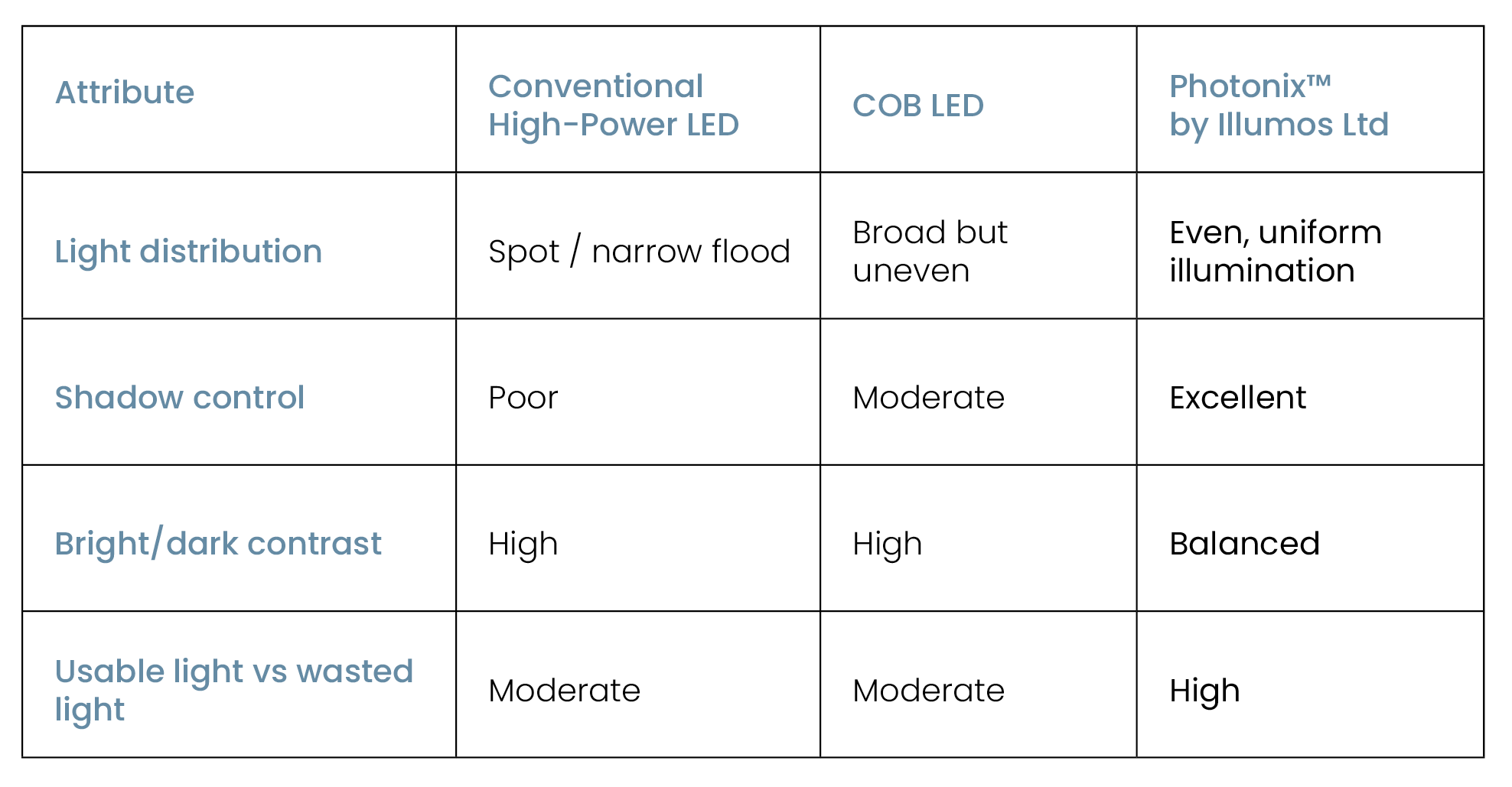
Bright hotspots paired with poorly lit corners
Eye fatigue during extended tasks
From a fleet perspective, this matters. Poor lighting doesn’t just reduce comfort—it can slow task completion, increase error rates, and contribute to safety incidents.
Why More Lumens Don’t Always Improve Productivity
Human vision is highly sensitive to contrast and glare. When lighting is overly intense or poorly diffused:
Workers lose detail in darker areas as pupils constrict
Reflections wash out labels, wiring, and fasteners
Visual fatigue increases, especially during night operations
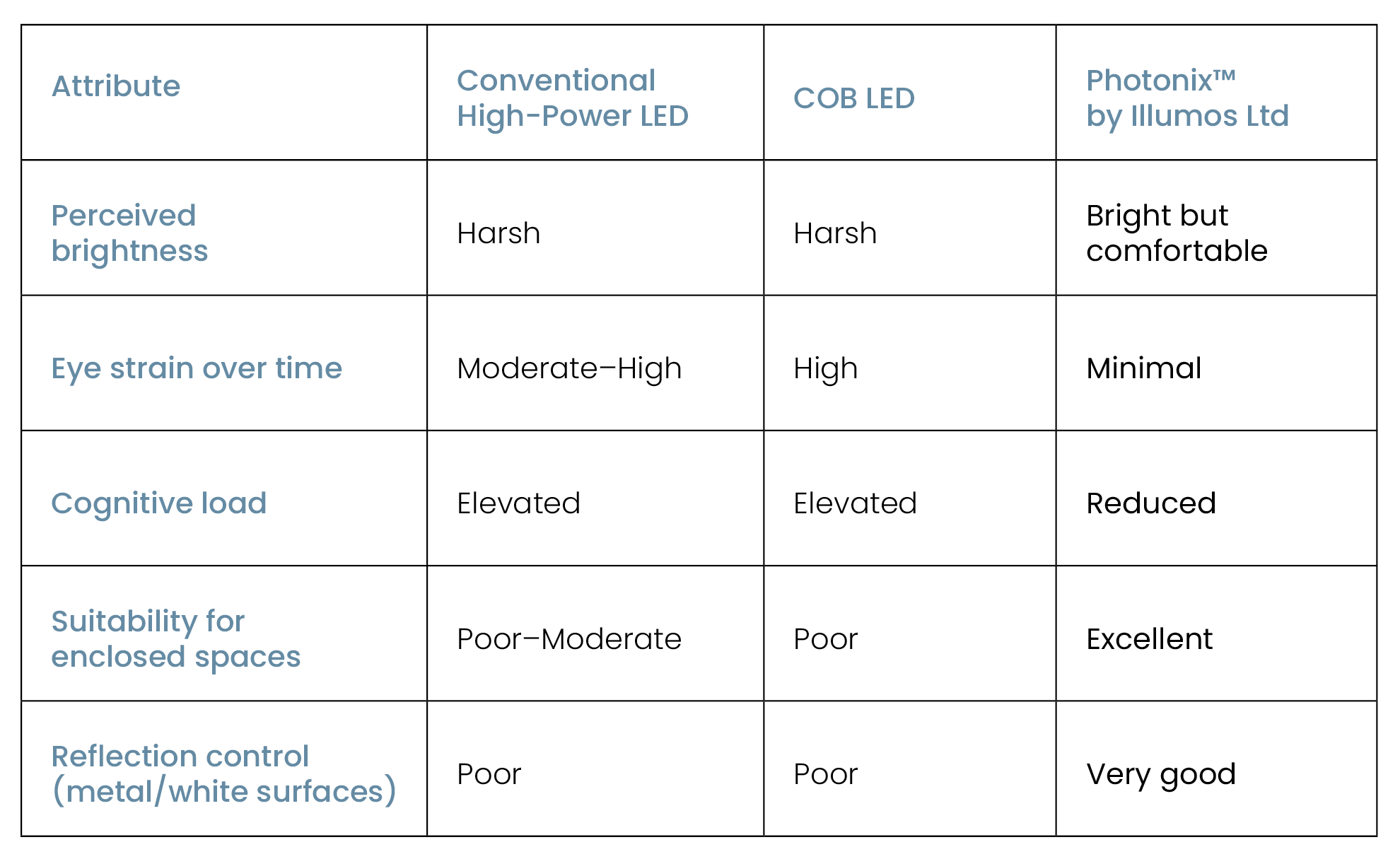
In enclosed spaces like trailers, the problem is amplified. White walls, metal surfaces, and glossy equipment reflect high-output LEDs directly back into the user’s field of view.
From an OEM or fleet engineering standpoint, this means a lighting system can technically meet specifications—and still fail in real-world use.
A Shift in Thinking: From Output to Usability
Just as headlight design has shifted away from raw brightness toward controlled illumination, fleet and work lighting benefit from the same mindset.
The key change is not reducing light levels, but rethinking how light is generated, distributed, and perceived by the human eye.
Photonix™ by Illumos Ltd was developed specifically to solve the problems created by high-intensity LED work lighting—not to mask them with diffusers or secondary optics, but to eliminate them at the source.
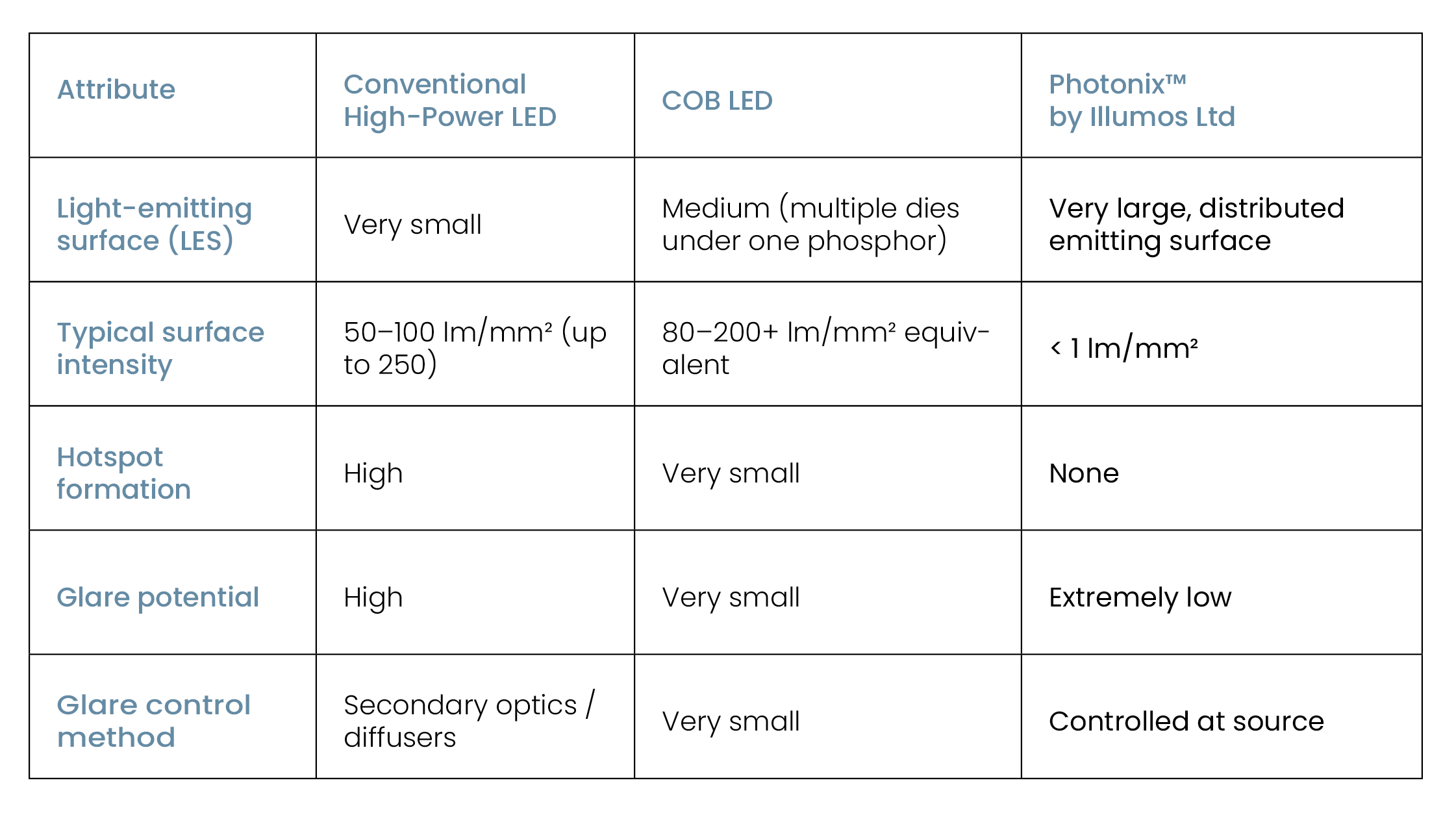
Modern LEDs are extremely bright at the emitter level, typically producing 50–100 lumens per mm² of light-emitting surface, with some reaching 250 lm/mm². Even COB LEDs, despite their larger apparent size, still concentrate multiple dies under a single phosphor coating—often increasing perceived intensity, glare, and visual discomfort.
Photonix™ fundamentally changes this equation.
Rather than concentrating light into a small, intense source, Photonix™ spreads high total lumen output across a significantly larger emitting surface, reducing intensity to less than 1 lumen per mm². This ultra-low surface brightness removes the root cause of glare and eliminates visible hotspots—without sacrificing usable illumination.
This source-level control is especially critical in enclosed and reflective environments such as trailers, service bodies, and mobile workshops, where conventional high-output LEDs frequently create harsh reflections and visual fatigue.
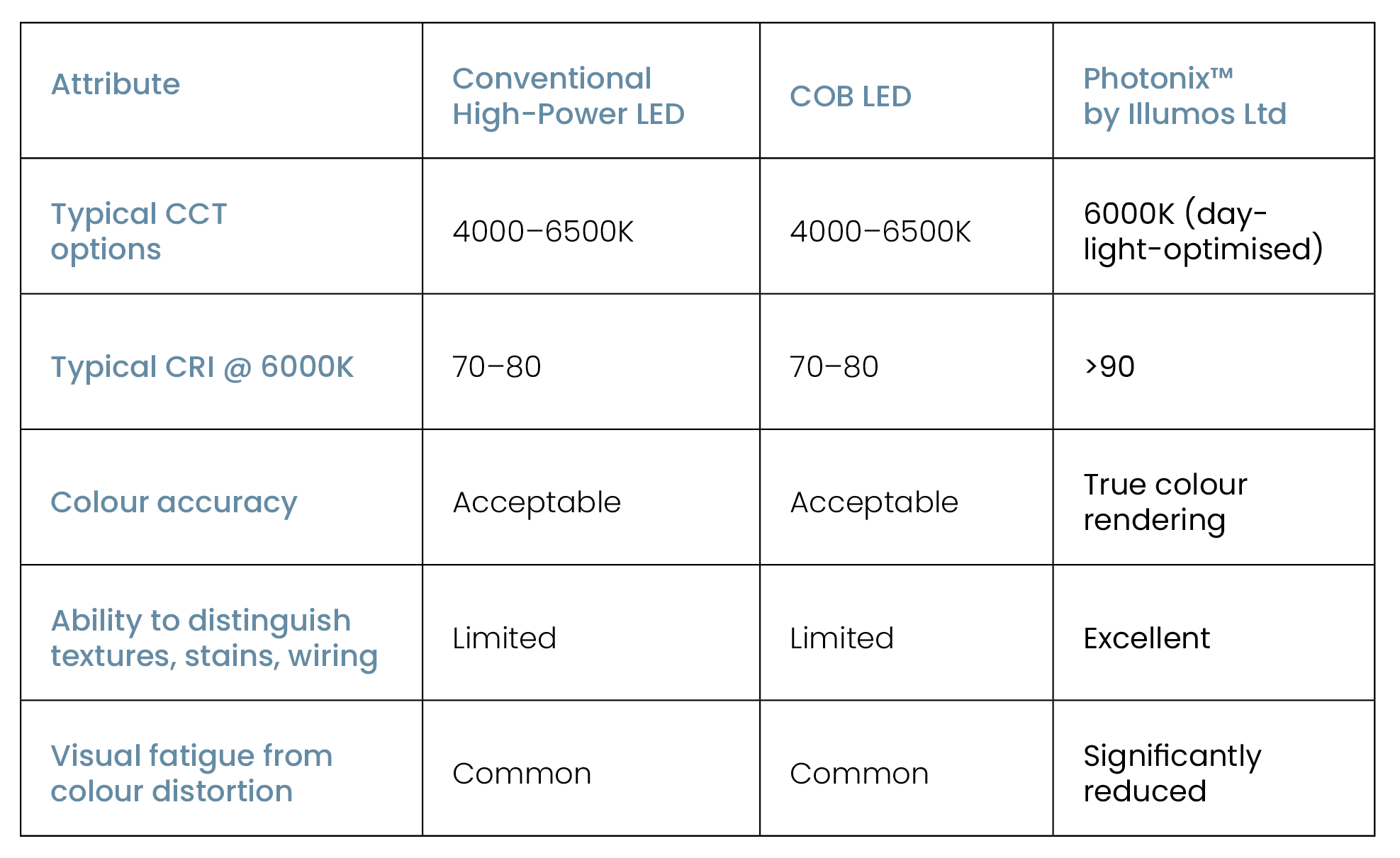
Colour performance is treated with the same engineering discipline. Photonix™ operates at 6000 Kelvin, closely aligned with natural daylight conditions—between direct sun and overcast—making it ideal for task-focused environments where alertness, contrast, and clarity matter.
What truly differentiates Photonix™, however, is colour accuracy. Achieving a CRI greater than 90 at 6000K is exceptionally rare. Most 6000K LEDs operate at 70–80 CRI, producing light that appears unnaturally harsh and forcing the brain to constantly reinterpret colours. This ongoing cognitive correction increases mental load, accelerates fatigue, and contributes to eye strain during extended tasks.
Photonix™ eliminates this issue by delivering true colour illumination. Technicians can more easily distinguish between stains and shadows, wiring colours, surface textures, and potential leaks—improving accuracy, speed, and confidence in the work being performed.
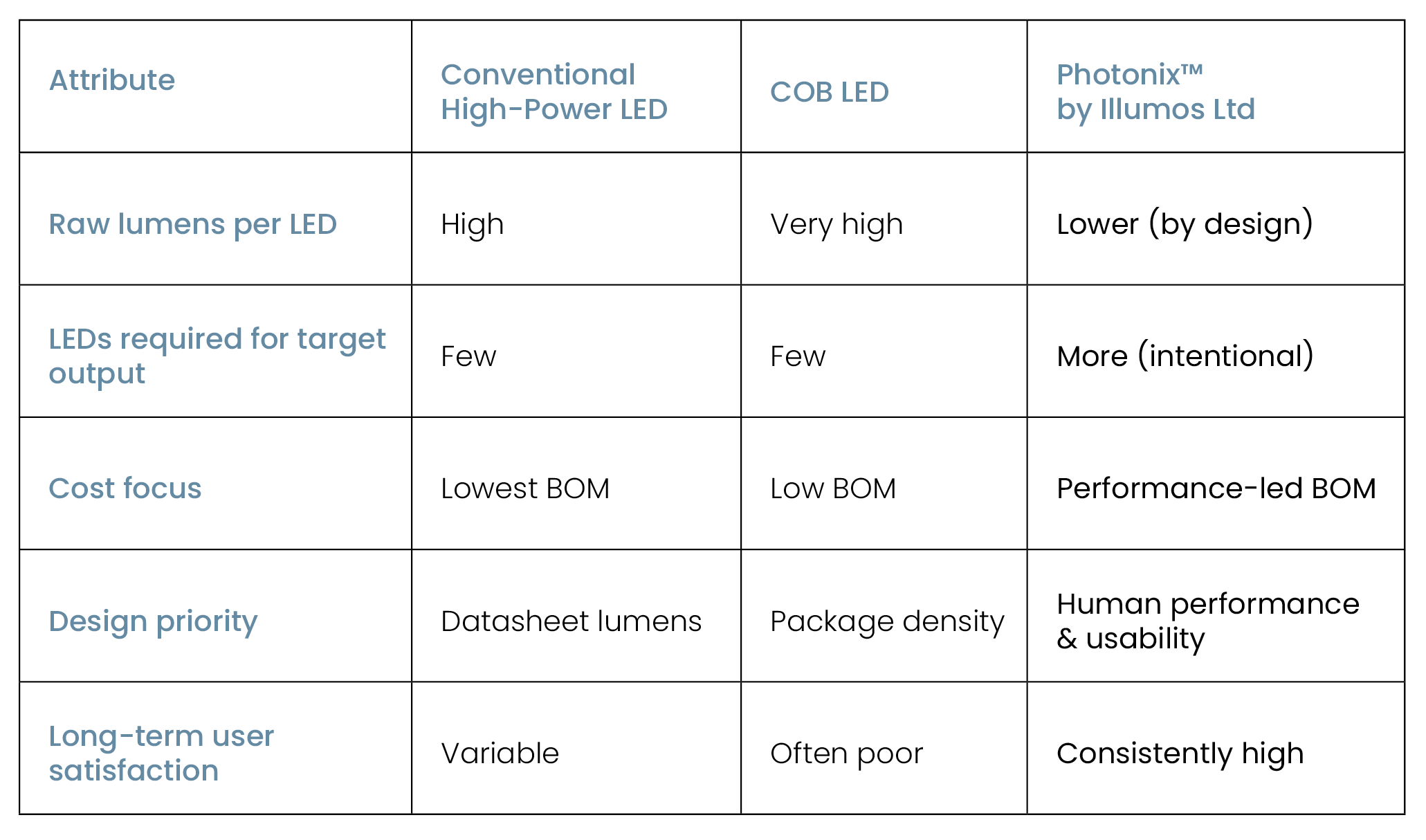
This performance is not accidental. Achieving high CRI at 6000K requires sacrificing raw light output per LED. Photonix™ intentionally accepts this trade-off, compensating by using a greater number of LEDs to achieve required lumen levels. While this increases system cost, it is a deliberate design decision—placing human performance, comfort, and long-term usability ahead of datasheet-driven lumen optimisation.
In practice, Photonix™ aligns precisely with emerging best practices in fleet lighting design, which increasingly favour:
Controlled surface brightness rather than maximum intensity
Even, glare-free illumination instead of hotspot-driven output
Lighting designed around human vision, not laboratory metrics
For OEM builders and fleet specifiers, Photonix™ represents a shift from “how bright is it?” to “how well does it work—hour after hour, shift after shift?”
Technical Comparison:
Photonix™ vs Conventional LED & COB Work Lighting
Light Source Architecture
Visual Comfort &
Human Factors
Colour Performance
Illumination Quality
System Design &
Trade-Offs
Application Suitability
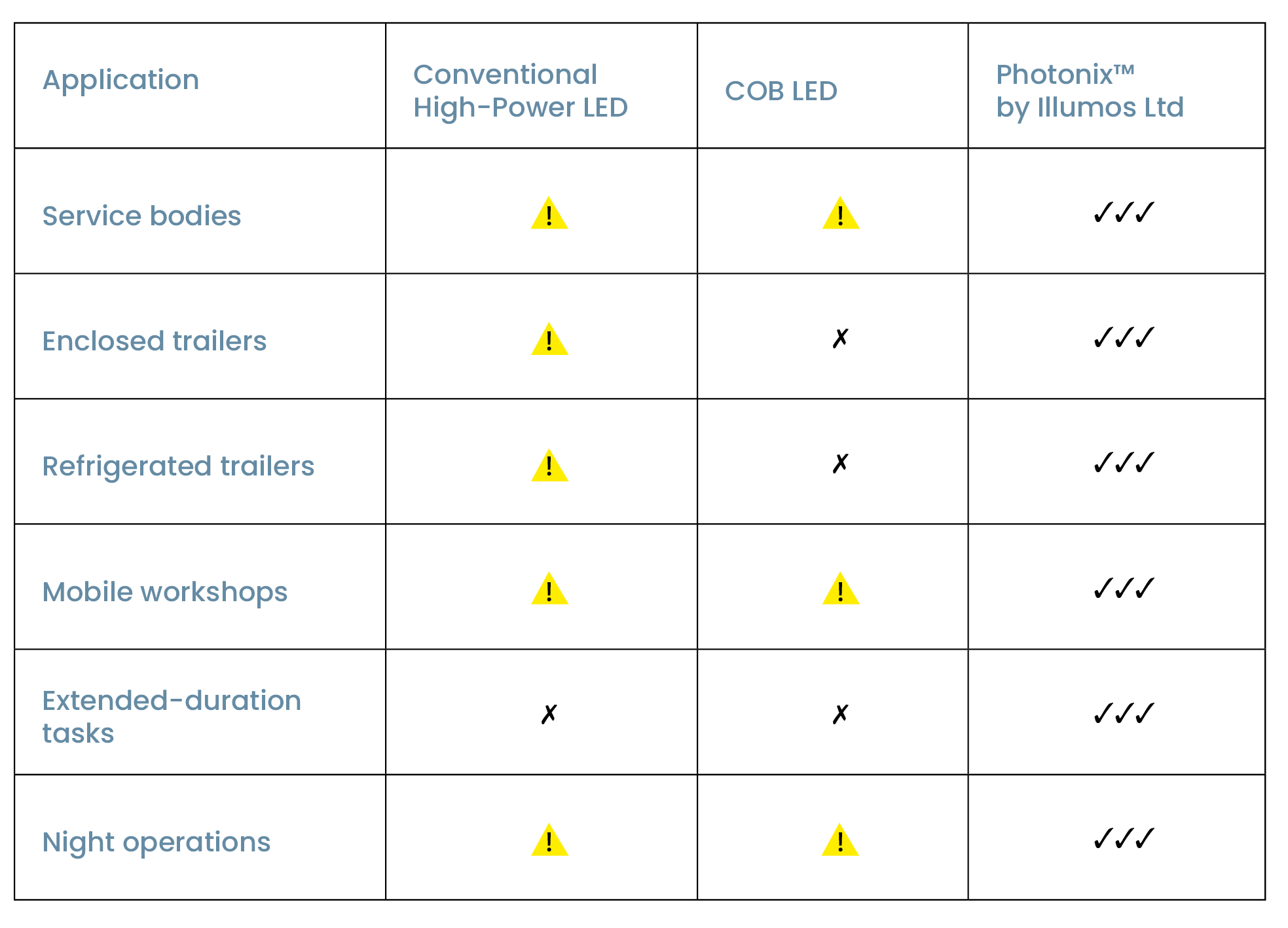
✓✓✓ = Ideal
⚠️ = Compromised
✗ = Poor fit
Engineering Summary
Conventional LEDs and COBs prioritize lumen density and package efficiency, often at the expense of glare control and human comfort.
Photonix™ prioritizes surface brightness control, colour accuracy, and visual ergonomics, addressing glare and fatigue at the emitter level rather than attempting to correct them downstream.
For OEM builders and fleet specifiers, Photonix™ represents a fundamentally different lighting philosophy:
not “how many lumens can we generate,” but
“how effectively can those lumens be used by the human eye in real working conditions.”